
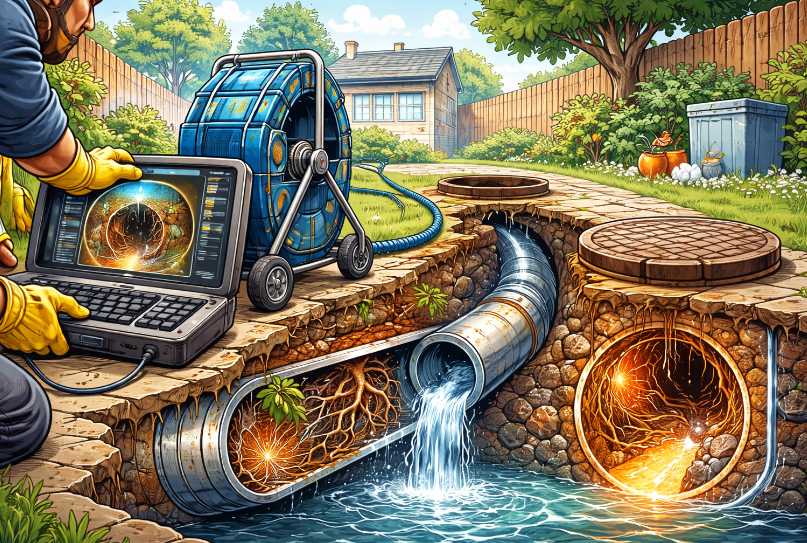
A CCTV drain survey is essentially an underground inspection using a specialist camera. It doesn’t rely on hunches, and it doesn’t require someone to dig up your garden just to “have a look.” Instead, it creates a clear view of what’s happening inside the pipework, allowing problems to be identified with precision rather than persistence.
How the Inspection Works Without Turning Your Home Into a Construction Site
The process is straightforward: a technician feeds a waterproof camera into the drainage system through an access point such as a manhole or rodding eye. The camera transmits live video to a monitor, and in many cases the footage is recorded for later review. Some camera heads can rotate, zoom, and self-level, which means the operator isn’t just seeing “something dark and wet.” They’re seeing the pipe’s condition in detail.Many surveys also use a locator device to track the camera’s position from above ground. That makes it possible to mark the exact spot of a defect—useful if a repair is needed, and extremely useful if you’d rather not excavate your entire patio in the name of curiosity.
A proper report typically includes notes on pipe material, diameter, the direction of flow, and the location and severity of any defects. The serious part: this documentation can be valuable for insurance discussions, home purchases, or planning repairs. The less serious part: it’s also the closest most people will ever get to a guided tour of their own private underground waterpark.
What It Actually Reveals Down There
Drains fail in surprisingly predictable ways, and cameras are very good at spotting the early stages—before they become expensive emergencies. Common findings include:- Grease build-up and scale narrowing the pipe (the slow-motion version of a blockage)
- Tree root intrusion through joints or cracks
- Cracked, fractured, or collapsed sections of pipe
- Misaligned joints where pipes have shifted over time
- Bellies or “sags” in the line where water sits instead of flowing
- Foreign objects lodged in awkward places (some of them very committed to staying)
Why Early Diagnosis Saves Money
When a drain issue is handled early, the fix is often simpler: targeted cleaning, root cutting, patch repairs, or a short section replacement. When it’s ignored, the costs tend to grow in three directions at once: bigger damage, bigger disruption, and bigger urgency.A small crack can become a collapse. A slight misalignment can turn into repeated blockages. Water leaking into soil can wash away support around the pipe. If the ground shifts, the pipe shifts more, and the cycle accelerates. By the time a full failure announces itself, it rarely does so politely.
A CCTV survey reduces the risk of paying for the wrong solution. Instead of repeated call-outs to clear “another blockage,” you can address the underlying cause once. That’s the long-run savings people notice most: fewer repeat problems and fewer surprise repairs.
When a Survey Makes Sense
Some situations practically invite a camera inspection. Recurring slow drainage is one. Foul odours that return quickly after cleaning is another. If you’re buying a property—especially an older one—a survey can reveal issues that don’t show up during a standard viewing. Drains can look perfectly innocent right up until they are very much not.It’s also useful after major building work, when heavy machinery and ground movement can affect underground pipework. And if you’ve had a serious blockage or flood, a survey can confirm whether the system is actually healthy or merely resting between incidents.
Reading the Report Without Needing a Plumbing Degree
Once the inspection is complete, you’re usually presented with footage and a written report. At first glance it can feel technical, filled with references to joints, gradients, and defect codes. Fortunately, the essentials are easier to grasp than they appear.A clear system will show smooth pipe walls, consistent alignment at joints, and steady water flow without pooling. Minor staining or light scaling is common and not necessarily alarming. More serious issues are typically flagged with descriptions such as fractures, displacement, root ingress, or deformation.
Pay attention to severity ratings. A small hairline crack may be noted for monitoring rather than immediate action. A displaced joint allowing soil to enter the pipe is more urgent. The key value of the report is prioritisation. It separates “keep an eye on it” from “address this before winter.”
Serious note: documentation matters. If a repair is recommended, the recorded footage provides objective evidence. That can support insurance claims, warranty discussions, or negotiations during a property purchase. It replaces opinion with proof.
Avoiding the Dig First Ask Questions Later Approach
Without a camera survey, diagnosing underground problems can involve educated guesswork. That sometimes leads to exploratory digging, which is exactly as disruptive as it sounds. Lawns suffer. Driveways crack. Flowerbeds become archaeological sites dedicated to last summer’s petunias.A targeted survey changes that equation. If a defect is found three metres from the inspection chamber and slightly to the left, that’s where attention goes. Not five metres. Not the entire garden. Precision saves labour time and reinstatement costs.
It can also reveal when digging isn’t required at all. Many structural issues can be resolved using trenchless repair methods such as lining or patching, which reinforce the pipe internally. Without the visual confirmation provided by CCTV, those options might never be considered.
Normal Wear Versus Real Trouble
Drains age like everything else. Slight discolouration, minor joint wear, or light scaling can be part of normal use. Not every imperfection signals impending disaster. An experienced operator distinguishes between cosmetic wear and structural compromise.Real trouble tends to involve movement, separation, or intrusion. Roots growing into a joint are not decorative. A section of pipe that has sunk and holds standing water will likely worsen over time. These are the findings that justify proactive repair rather than patient optimism.
Recognising this difference prevents overspending. It also prevents underreacting. Both are expensive in their own way.
Keeping Costs Underground Where They Belong
Long-term savings rarely come from dramatic last-minute fixes. They come from early awareness and measured response. A CCTV drain survey provides that awareness. It offers clarity before symptoms escalate and helps avoid repeated temporary solutions.Instead of reacting to each blockage as if it’s an isolated event, you gain an understanding of the system as a whole. That perspective allows for planned maintenance rather than emergency repair. Planned work is almost always more affordable than urgent work.
Drains are easy to ignore because they are out of sight. A camera changes that. It replaces uncertainty with information and reduces the likelihood of costly surprises emerging from beneath your feet. When it comes to underground pipework, seeing really is saving.
Article kindly provided by drainage-plumbing.co.uk